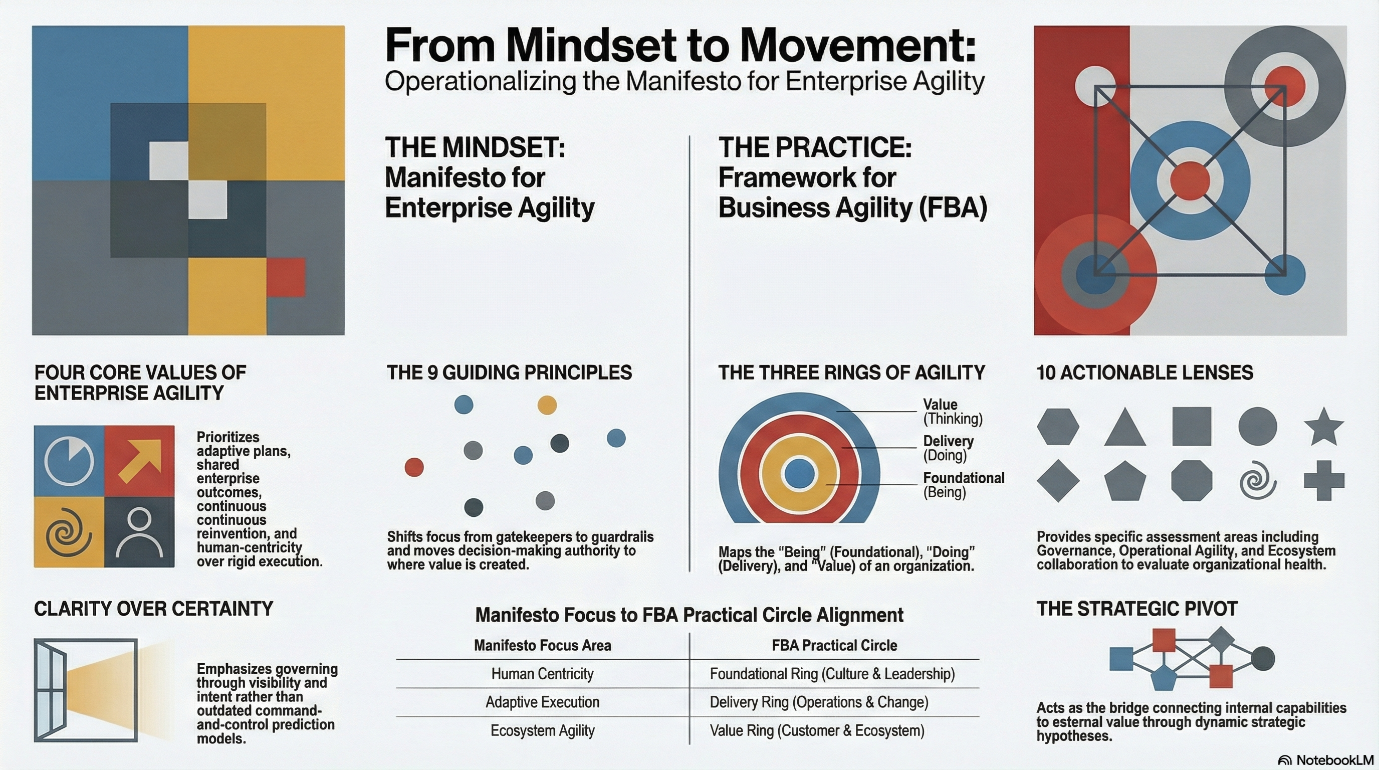
Manifesto for Enterprise Agility: From Principles to Practice
The newly launched Manifesto for Enterprise Agility, developed by PMI and the Agile Alliance with contributions from leaders and practitioners across the global agility community, highlights the growing importance of organisational adaptability in an increasingly complex world.
The Agile Business Consortium was pleased to contribute perspectives during its development and help connect contributors from across the business agility ecosystem.
The Manifesto for Enterprise Agility sets out principles designed to help organisations move beyond rigid, hierarchical ways of working and develop enterprise agility. This enables organisations to respond to change, empower teams, and focus more clearly on delivering value.
What is the Manifesto for Enterprise Agility?
The Manifesto for Enterprise Agility outlines principles intended to help organisations become more adaptive, resilient and responsive in complex environments. Rather than focusing purely on team-level agile practices, it highlights the need for agility across leadership, strategy, governance and organisational culture.
These themes will be familiar to many organisations already exploring business agility. Over the past decade, the conversation around agility has increasingly shifted beyond software delivery towards how organisations operate as a whole. For many organisations, however, the challenge is not agreeing with these principles. Most leaders recognise the need for greater adaptability, faster learning and more empowered teams.
The real question is: what does this mean in practice?
How do organisations translate these ideas into how strategy is set? How decisions are made? How governance works? How teams operate day-to-day? Turning principles into practical organisational change is where many transformation efforts struggle.
Translating Principles into Practice
Developing enterprise agility rarely happens through a single framework or initiative. It requires coordinated change across leadership, strategy, governance, culture and operational delivery.
Over many years, the Agile Business Consortium has brought together practitioners, leaders and researchers exploring these challenges and has developed the Framework for Business Agility (FBA) as a way to help organisations navigate this complexity. The framework provides a holistic view of how agility can evolve across strategic direction, organisational coordination and operational delivery.
Three perspectives are particularly important when bringing the ideas behind enterprise agility to life.
The Strategic Perspective: Creating Clarity of Direction
The manifesto emphasises the importance of clarity of purpose and the ability for organisations to adapt their direction as conditions change.
In practice, this often means shifting away from fixed long-term plans towards more adaptive strategic thinking. Organisations increasingly need to test strategic hypotheses, learn from real-world feedback and evolve direction over time.
The Agile Strategy and Ecosystem lenses within the FBA explore how organisations can create this clarity while remaining responsive to emerging opportunities and challenges.
Across the Consortium's communities, such as the Business Agility Think Tank, leaders share experiences and insights on how strategy can become more adaptive in practice.
The Coordination Perspective: Enabling Value Flow
The manifesto highlights the need for governance that provides clear guardrails while enabling teams to move quickly and make decisions closer to where value is created. For many organisations this requires rethinking how functions such as finance, HR, risk and legal support value delivery.
Within the FBA, lenses such as Agile Governance and Business Support Agility explore how enabling functions can evolve from control mechanisms into partners that accelerate organisational effectiveness.
The Consortium’s Special Interest Groups, including communities focussed on Agility in HR and Agility in Finance, provide spaces where professionals can explore how these shifts are happening in practice across different organisations.
The Team Perspective: Empowering the Front Line
Enterprise agility ultimately depends on teams that are empowered, collaborative and closely connected to customer outcomes.
The manifesto calls for authority and decision-making to move closer to where value is created. Achieving this requires organisational structures that support cross-functional collaboration, iterative delivery and continuous feedback.
The Operational Agility lens of the Framework for Business Agility explores how organisations can create the conditions for teams to operate effectively in this way.
Through learning pathways and certifications such as Agile Project Management (AgilePM®) and Agile Business Analysis (AgileBA®), practitioners and leaders can build the capabilities needed to support these ways of working.
Continuing the Conversation on Enterprise Agility
The publication of the Manifesto for Enterprise Agility reflects a growing recognition that enterprise agility is becoming a leadership and organisational capability, not simply a set of team-level practices.
Developing business agility is not something that can be implemented through a single initiative or methodology. It is a continuous learning journey that involves experimentation, reflection and collaboration across the organisation.
At the Agile Business Consortium we look forward to continuing the conversation across the global agility community — and to supporting organisations as they explore how the principles behind enterprise agility can be translated into practical, sustainable change.