
The Framework for Business Agility
A set of lenses for understanding how agile your organization really is, and how it could be more so. Developed through three decades of work with organizations striving to be adaptive in their own context.
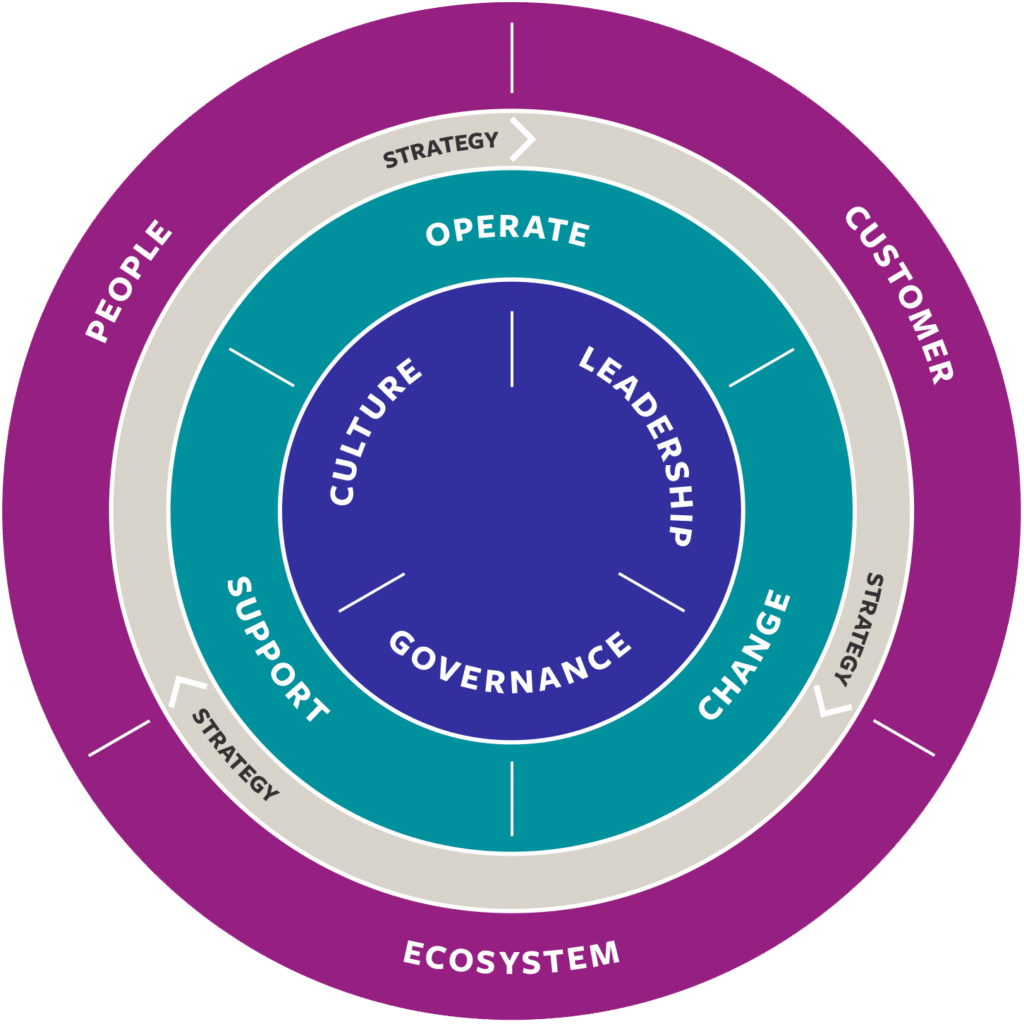
Inside the framework
It isn’t a model to implement. It’s a set of lenses you can use to assess the agility of your organization, identify where the friction is and find the right places to improve.
Method-agnostic, scalable from a team to an enterprise, and shaped by three decades of work with organizations putting it into practice.
The core
Culture, Leadership & Governance
Agile organizations start with their core. Leadership sets the vision and develops others to lead at every level. Culture defines how people interact, behave and grow together. Governance distributes authority to where the expertise lies, with just enough oversight to enable trust and effective coordination.
These three dimensions are foundational — they enable everything else. Without a strong core, agility elsewhere in the organization is only ever surface deep.
- Adaptive leadership at every level
- A culture rooted in psychological safety
- Governance that empowers rather than constrains


Delivery & Value
Operate, Change & Support
This is the engine room of the organization. Operate is how value is delivered day to day, adapting as customer needs and markets evolve. Change is how the organization responds when bigger shifts are needed — new products, new markets, new ways of working. Support functions like HR, Finance and IT move from controlling to enabling, becoming accelerators of value rather than constraints on it.
When the core is strong, this is where agility shows up most visibly in the work.
- Operational agility in day-to-day delivery
- Business change agility for bigger shifts
- Support functions that enable rather than constrain
The Scope
People, Customer & Ecosystem
Agility ultimately exists to serve people. Customers are the reason the organization exists, with success measured by the sustained value delivered to them. People within the organization are the powerhouse that makes everything else possible. Ecosystem represents the wider market, regulatory and social environment the organization operates in, and contributes to.
These are the dimensions that everything else optimizes for.
- Customers at the centre of every decision
- People trusted, valued and empowered to grow
- Ecosystem awareness as a strategic advantage


Threading through it all
Agile Strategy
Strategy threads through every dimension of the framework. Rather than fixed plans handed down from above, agile strategy is a continuous capability — testing hypotheses, learning from results and adapting direction as conditions change.
When strategy is agile, the organization maintains its focus on delivering value even as the world around it shifts.
- Strategic hypotheses tested through lean experiments
- Direction set by shared principles, not rigid plans
- Decisions distributed to those closest to the work
Put the framework to work
The Framework for Business Agility is free to access and free to use. Members get more, including practical resources, self-paced online courses and a community of practitioners using the framework in real organizations. So you can apply the lenses with confidence and keep growing your capability over time.