
Agile Strategy
Strategy threads through every part of the framework. Not as a fixed plan handed down from the top, but as a living capability that keeps the organization focused on delivering value even as the world around it shifts.
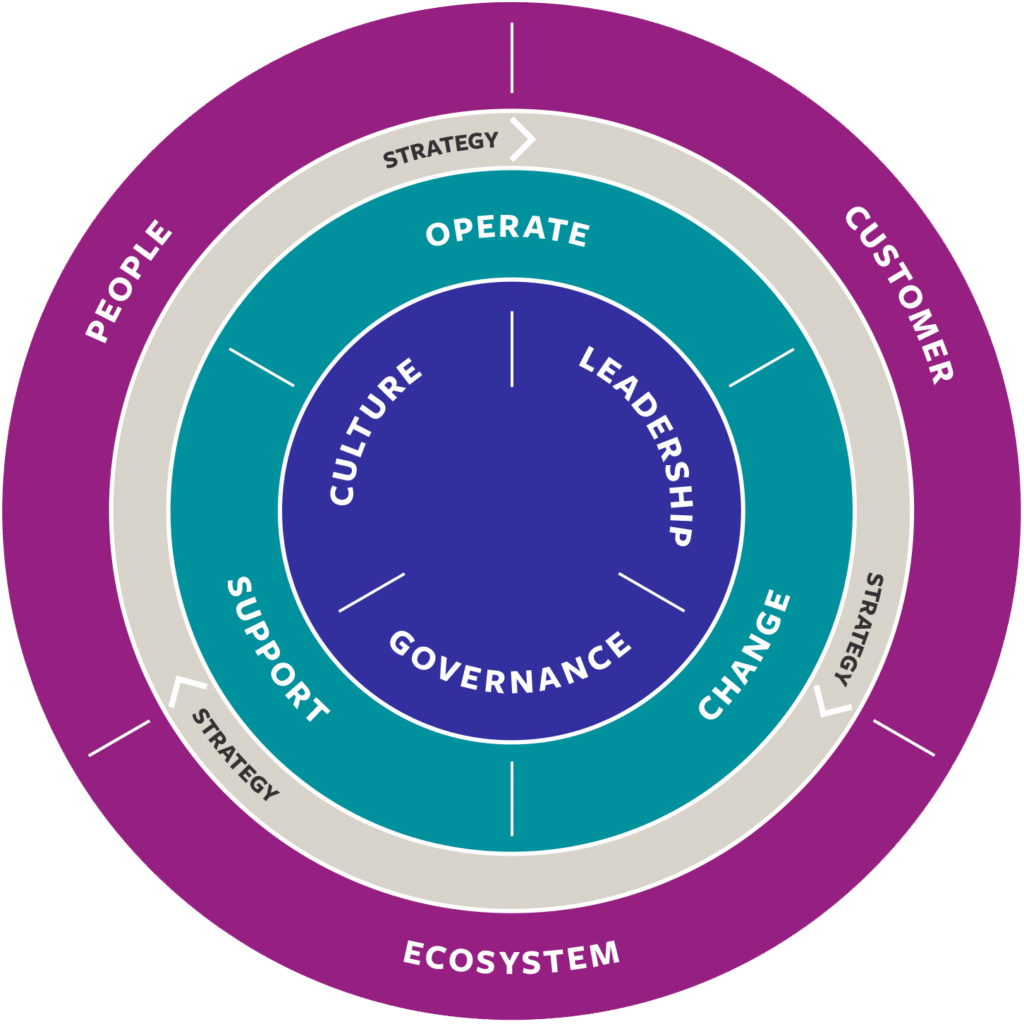
Strategy that adapts as the world does
Agile strategy is the capability to adapt your direction as conditions change, without losing sight of the value you exist to create. Guided by a shared North Star, it lets people throughout the organization make sound decisions and allocate resources with confidence. Rather than a plan set once and followed rigidly, it works as a continuous cycle of testing, learning and adapting. This lens helps you understand how readily your organization can change course while staying true to its purpose.
Agile Strategy
Agile strategy represents the organization’s capability to continuously adapt its strategic direction as conditions change, while maintaining focus on delivering value to customers, people, and ecosystem. It consists of guiding principles communicated throughout the organization that generate consistent decision-making patterns and enable learning and adaptation in a VUCA environment.
Rather than fixed plans implemented from the top down, agile strategy operates as an organizational competency. This happens through defining strategic hypotheses and testing them via lean experiments, holding regular (at least quarterly) strategic retrospectives, following dynamic cycles of defining-realizing-measuring-adapting, and maintaining transparent information sharing that enables rapid course corrections and speed to market.
Strategy becomes a distributed competency guided by a shared North Star. This allows people throughout the organization to make decisions and allocate resources using strategic principles.
Consider using approaches such as Agile Portfolio Management (AgilePfM) for strategic resource allocation and risk monitoring and response. Foundational approaches like OKRs (Objectives and Key Results) support the setting of goals and measurement of progress, and enable pivoting when hypotheses prove invalid. Running strategic experiments and regular retrospectives provide the rhythm and structure needed for adaptive strategic management.
Agile Strategy requires effective agility in culture, leadership, and governance. These foundational elements enable distributed strategic thinking and rapid strategic adaptation throughout the organization.