
Culture, Leadership & Governance
At the heart of every agile organization lies its core: the culture that shapes how people behave, the leadership that develops others to lead, and the governance that aligns autonomy with purpose. Without a strong core, agility elsewhere is only ever surface deep.
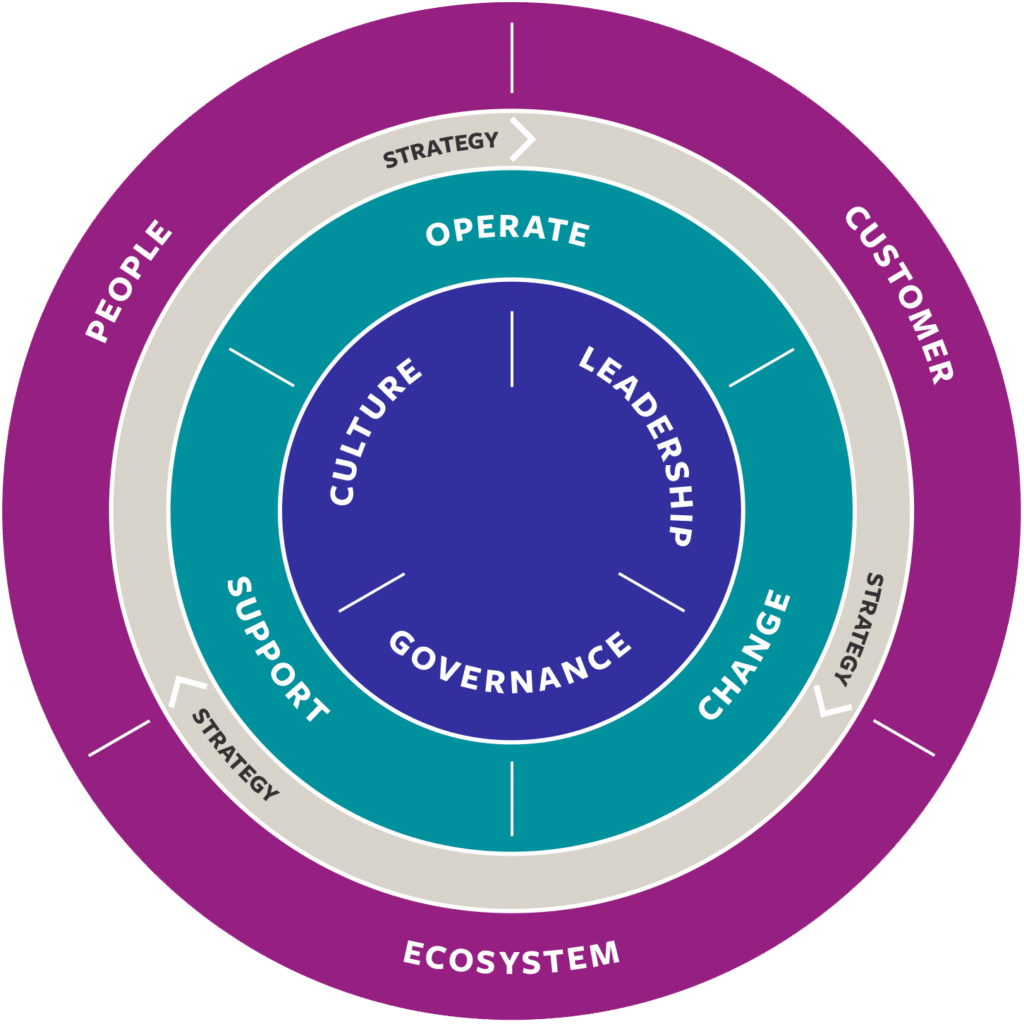
Where business agility begins
Culture, leadership and governance are the foundations everything else is built on. Get these right and you create the conditions for agility to take hold across the whole organization. Get them wrong and even the best delivery practices struggle to stick. These three lenses help you understand how strong your core really is, and where there’s room to grow.
Cultural Agility
An organisation’s culture reflects its personality – one that’s influenced by a range of factors, including its size, geographic spread, beliefs, and values. People and events also affect an organisation’s culture.
An agile culture provides an organization with a set of core values, behaviours and practices that allow it to prosper in a world characterized by volatility, uncertainty, complexity and ambiguity.
Its success also comes from promoting, encouraging, rewarding and harnessing the flexible and innovative behaviour of people within the organisation, by nurturing the three components of intrinsic motivation: autonomy, mastery and purpose.
There are seven elements that combine to form the DNA of an organisation’s agile culture, for which there is a Development Matrix for Agile Culture describing five levels of agility for each of the seven elements.


Leadership Agility
Individuals within an organisation are typically identified as leaders as a result of one or more of: Their knowledge and experience related to what they are leading; their competence as a leader; and/or their position within a hierarchy.
To create and sustain flexible, resilient and adaptable organisations, agile leaders seek to develop others as leaders at all levels, believing that everyone has the potential inherent in a growth mindset to deliver on a shared purpose.
To be credible and effective, agile leadership requires a willingness from those who lead to ensure that they extend their own competencies, capabilities and thinking to ‘being’ agile rather than just ‘doing’ agile.
There are nine principles for agile leadership that are aligned with the agile themes of communication, collaboration and commitment. These principles should be embraced by any leader wishing to harness the power of collective effort – regardless of the scale of the change or the authority they inherit from organisational structure.
Agile Governance
Agile governance represents a dynamic, value-driven approach to decision-making and oversight that enables organisations to remain aligned with their purpose and regulatory requirements, while adapting rapidly to changing conditions. Rather than governance that minimises harm through rigid controls, agile governance creates conditions that enable business agility and sustainable value creation.
This approach distributes authority to where information and expertise reside, with clear boundaries that prevent doing wrong things inadvertently, whilst keeping within the regulatory boundaries. It operates through empowerment at the lowest responsible level, alignment with organisational purpose, and transparency that enables trust and effective coordination.
In principle, governance is universal, pervasive and scaled. It is based on:
Empowerment – reliant on informed decision making, at the lowest responsible level, that is responsive and at pace.
Alignment – with the purpose and values of the organisation and any appropriate legislation.
Transparency – easy for people internal and external to the organisation to see what is going on and when intervention is needed. Providing an auditable record of activity where needed to demonstrate compliance and appropriate management of risk.
Agile Governance applies minimal viable governance—just enough to ensure effectiveness and compliance, with each mechanism justified by the value it adds. It values radical transparency, trusted autonomy, collaborative responsiveness and informed judgement. ,It requires active commitment and participation throughout the organisation to enable decisions by those who know, rather than those with positional power.
Agile Governance is facilitated by principles-based approaches that create consistency without requiring uniformity. Dynamic adaptation ensures governance frameworks remain agile, evolving as organisational needs change. Focus is on delivering value to customers, people, and ecosystem, rather than creating bureaucratic artifacts.