
Operate, Change & Support
This is the engine room of the organization. Where value gets delivered day to day, where bigger changes are made, and where support functions either accelerate the work or quietly hold it back. When the core is strong, this is where agility shows up most visibly.
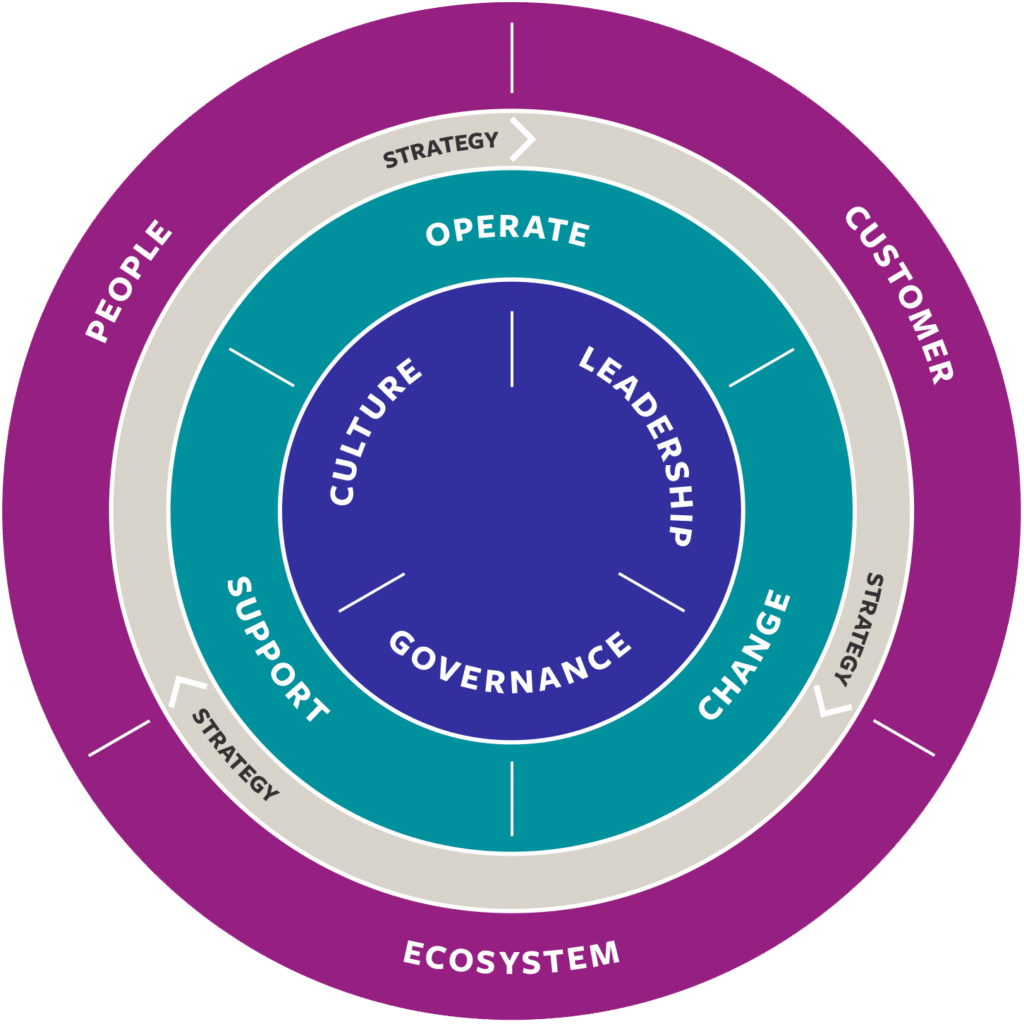
Where value gets delivered
Operational agility keeps day-to-day delivery adaptive as customer needs shift. Business change agility handles the bigger transitions, from new markets to whole transformations. And business support agility turns functions like Finance, HR and Procurement into accelerators rather than constraints. Together, these three lenses help you understand how well your organization delivers value today, and how readily it can adapt when the work demands it.
Operational Agility
Agility in business operation, business change and the internal support of these are at the heart of every business that is able to survive and thrive in a VUCA world (one characterized by Volatility, Uncertainty, Complexity and Ambiguity).
Operational agility is the organization’s capacity to adapt day-to-day value delivery as customer needs, markets, and ecosystems evolve. Most agile methods and frameworks operate here, enabling teams to respond to change while maintaining sustainable value creation. (Agile) Product Management typically sits in this part of the FBA.
In a VUCA world, what customers value, or what people and ecosystems require, shifts continuously. Value delivery processes must be adaptive to ensure sustainable, cost-effective delivery. Organizations balance operational efficiency with the capability to respond rapidly when what’s valuable changes.
This occurs through customer-centric delivery, experimental methods including MVPs (Minimal Viable Product) and proof of concepts, flow-based working, and empowered teams working within clear boundaries.
Consider methods or frameworks such as AgilePM, Lean, XP, DA / DAD, LeSS, SAFe, or AgileDS for digital products and services. Scrum and Kanban can be applied across areas depending on context and are not specifically focused on digital delivery.
When pressure for change exceeds operational capacity, or when there are needs beyond improving products and services (for example, when entering new markets, or when people need to change their behaviours), the Business Change Agility lens (described later) provides more appropriate guidance.
These capabilities exist on a continuum. Operational agility depends on the organization’s culture, leadership and governance—foundational elements that enable or constrain delivery effectiveness.


Business Change Agility
Where pressure for change exceeds the capacity and capability of operational agility, a special response may be needed. This is achieved through agility in business change that exists in a continuum with operational agility.
Examples of such changes may include: Changing the way the organization operates to comply with new regulations; bringing new products or services to market; moving existing products and services to new markets; and transforming the business – either to meet a new purpose or to achieve an existing purpose in a significantly different way.
In order to be successful, these larger changes, often need to be organized alongside the day-to-day operation of the business in a way that allows the value of the change to be delivered incrementally and as early as possible but without creating turbulence that risks overwhelming the operation.
Transformational initiatives to develop significant new products, services or capabilities and ensure that the value of these are fully realized, e.g. by changing operational value delivery processes, support processes, and/or bringing about change in culture, governance and leadership often need to be managed as agile projects or programmes.
Business Support Agility
Agile Business Support processes enable the organization to deliver value to People, Customers and Ecosystem. They don’t directly deliver value themselves.
Business Support Agility transforms enabling functions, such as Finance, HR, Procurement, Marketing, Facilities etc., from constraints into accelerators of value delivery. While these functions don’t directly create customer value, their agility is essential for organizational responsiveness and growth.
Agile support functions enable rapid response to opportunities and challenges, foster growth mindsets, enable strategic pivoting through flexible resource allocation, and support value delivery through streamlined processes.
Support functions can create constraints: inflexible financial processes can prevent resource reallocation, restrictive HR policies can inhibit collaborative work, rigid procurement can limit relationship adaptability, overly structured marketing can miss new opportunities, inflexible facilities can inhibit collaboration, etc.
Agile Business Support functions address these potential constraints systematically. Finance moves toward flexible approaches like Beyond Budgeting. HR develops policies encouraging collaborative work while building the required competencies, recognizing work in teams and M-shaped functions. Procurement develops adaptive partnerships. Marketing maintains openness to new opportunities. Facilities support effective collaboration. As a starter for change in these functions, many start by using SCRUM or Kanban as collaborative working methods.