
What is Business Agility?
Business agility is an organizational capability that enables businesses to rapidly adapt to market changes, embrace unexpected disruptions, and seize new opportunities.

Business agility is an organizational capability that enables businesses to rapidly adapt to market changes, embrace unexpected disruptions, and seize new opportunities through flexible, innovative, and people-centric approaches; all while still delivering value.
Imagine it is like an organization being able to shift gears effortlessly.
There is a balance between “being agile” through culture, leadership and governance with “doing agile” in delivery. It involves shifting from rigid hierarchies to a culture of continuous learning, enabling teams to deliver value quickly while staying resilient.
Business agility is not a rigid framework or methodology to simply implement.
“Business agility is what allows organizations to respond to change with confidence, keep their people aligned, and continue delivering value when the world around them shifts.”
Karen McAllen, CEO, Agile Business Consortium
What is an Agile Organization?
An agile organization is a human-centric organization that responds and adapts quickly to change while creating sustainable value for customers, employees and stakeholders.
This is achieved through the interplay of strong foundations (culture, leadership and governance) with dynamic delivery capabilities (operations, support, and change). These combined enable organizations to:
- Adapt rapidly to market shifts while maintaining strategic direction.
- Respond to customer needs through empowered teams and collaborative networks
- Lead purposeful change that delivers results without sacrificing quality or people
- Build lasting resilience rather than just competitive advantage
- Learn and evolve continuously through experimentation and adaption
An agile organization is not defined by the frameworks it uses, but how it thinks and acts.
The Framework for Business Agility
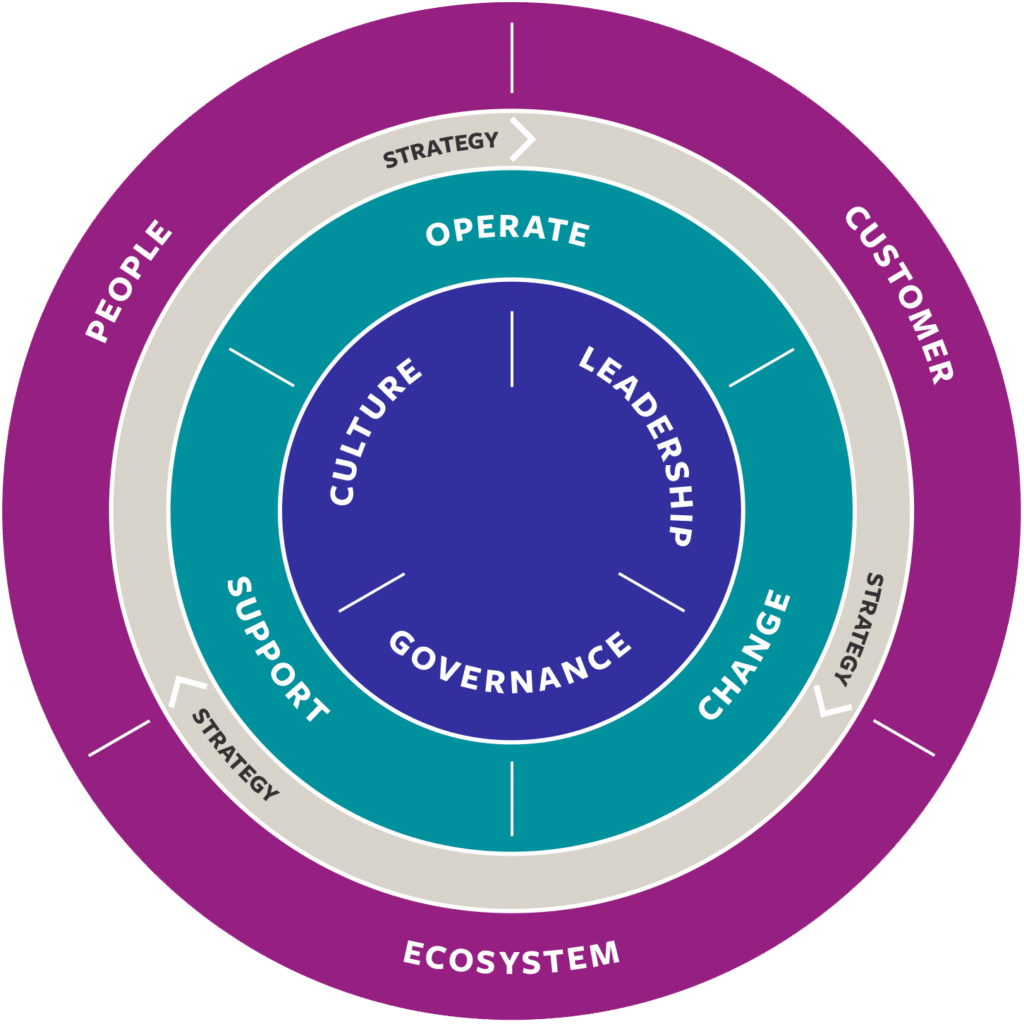
The Agile Business Consortium developed the Framework for Business Agility (FBA) to help organizations to get a holistic, agnostic view of the agility of their teams and organization as a whole.
This framework consists of 10 elements; the agility an organization has in each element will influence the way it operates and evolves in response to change.
Why does Business Agility matter?
The world is constantly evolving, and organizations today encounter various challenges, such as:
- Market disruptions from emerging competitors and shifting customer expectations
- Economic uncertainty stemming from both global and local financial changes
- Technology advancements like AI, automation, and digital transformation
- Talent challenges related to attracting and keeping skilled employees
- Sustainability and ESG pressures to achieve environmental and social goals
Organizations that depend on slow decision-making, ridged processes and outdated frameworks risk being left behind. Business agility provides organizations the flexibility to pivot when needed.
What are the benefits of Business Agility?
The benefits of business agility extend beyond being able to respond to change. Organizations that adopt business agility:
- Higher Revenue Growth
- Increased Employee Engagement and Satisfaction
- Improved Customer Satisfaction
- Better Operational Performance
Sources: Business Agility Institute’s Business Agility Report (2025), McKinsey & Co. Enterprise agility: Buzz or business impact? (2020),
How are leading organizations implementing Business Agility?
Many organizations, large and small, have adopted business agility and provided them with measurable results. This includes organizations highlighted below:
ShopRite X
ShopRite X embraced a fail-fast, fail-forward mindset, encouraging teams to experiment with new ideas, learn quickly from their mistakes, and adapt accordingly. They emphasised that taking responsibility for failures should not be feared but seen as a chance to grow and improve. This approach fostered a workplace where innovation could flourish without the fear of blame or punishment.
Roche Serbia
Roche-Serbia improved healthcare with agility by becoming more flexible and responsive. Their transformation focused on agility, leading to better collaboration with stakeholders, the introduction of innovative treatments, and stronger partnerships, demonstrating that agility benefits are not just internal operations but the entire system.
Liberty Special Martkets
Liberty Speciality Markets used a structured coaching approach, based on the International Coaching Federation (ICF) model, to strengthen leadership skills, self-confidence, and motivation. This method facilitated lasting change, allowing transformation to occur organically within the organisation.
Evaro
Evaro shifted its focus from outputs to outcomes Instead of just monitoring the speed of releases, the company began prioritising meaningful patient and business outcomes. The introduction of PR FAQs (inspired by Amazon) ensured that every initiative was aligned with patient needs and business impact before resources were allocated for development.
Written by

Become a Member
Join today for exclusive member events, expert insights, practical resources and a global network of agile practitioners.
Not ready for membership?
Register for free to access selected content, follow upcoming events and get a feel for the Agile Business Consortium community.
Related blogs





Membership for people leading change
Become a member to access agile communities, practical on-demand courses and exclusive events that help you build capability, grow your network and lead change with confidence.
Use code DISCOVER20 during checkout to save 20% off your membership. Valid until 31 July 2026.
Looking for organizational membership? Find out more here