
All Under One Roof: How Mohammed Bin Rashid Housing Establishment Made Collaboration Count
Discover how Mohammed Bin Rashid Housing Establishment transformed public housing services through collaboration, shared ownership and citizen-centred agility.
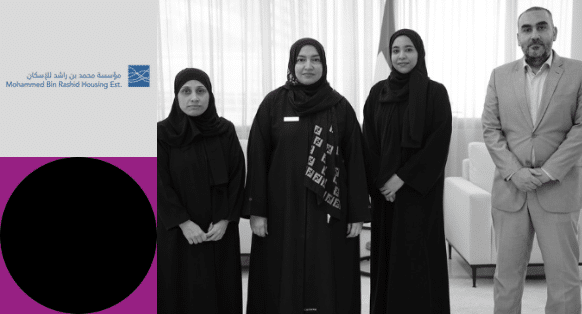
This is a case study from our Agility Impact Awards 2026 series. Mohammed Bin Rashid Housing Establishment were awarded in the Collaboration category.
A housing service may cross departments, government bodies, banks, and private companies. The citizen still experiences one journey. Mohammed Bin Rashid Housing Establishment’s award-winning story shows what changes when all organizations involved take shared responsibility for that journey.
Imagine being ready to build or buy a home, but first having to gather 15 service requirements, make four visits to government offices and wait as long as 60 days. Behind that experience, different departments and organizations may each be completing their own part of the process correctly. From the citizen’s point of view, however, the boundaries between them create more work, more uncertainty, and more waiting.
That was the challenge facing Mohammed Bin Rashid Housing Establishment (MBRHE) in Dubai. The housing journey depended on government entities, financial institutions, private-sector partners, and teams inside MBRHE. They were connected by the service, but they were not yet operating as one system.
MBRHE’s response earned the Collaboration award in this years’ Agility Impact Awards because it went further than asking people to communicate more often. The establishment redesigned ownership, governance, data exchange, and decision-making around the complete citizen journey.
This story offers a practical example for anyone leading change across organizational boundaries, whether in housing, local government, customer service, digital transformation, or programme delivery.
The customer saw one journey but the system saw many
The problem was not a lack of effort; it was fragmentation. Separate organizations had different responsibilities, processes, data formats, approval times, and communication routes. That structure placed the work of joining the system together onto the citizen. People carried documents between providers, repeated information and waited while decisions moved through disconnected channels.
This challenge will be familiar to transformation and project leaders. A service can perform well against a departmental target while still feeling slow and complicated to the person using it. A digital form may improve one interaction without removing the next handoff. A partnership may exist on paper while each organization continues to measure and manage only its own contribution.
MBRHE reframed the question. Instead of asking how each team could complete its step faster, it asked how the whole housing journey could become simpler and faster for the citizen. That change in perspective created a common outcome around which departments and partners could organize.
Listening changed the answer
Citizen-centered design began with direct evidence. MBRHE’s 360 team selected services with high transaction volumes and contacted people who had used them. The questions were straightforward: what went well, and what went badly? Monthly survey responses, follow-up conversations, and customer personas helped teams see the service from outside their own processes. Citizens also participated as parts of the journey were redesigned.
One of the most important changes came from a customer suggestion. Building a new community takes time.
Some citizens asked why, if MBRHE did not have suitable housing available, could it not provide the finance and allow them to buy an existing property from the private market. MBRHE developed that idea into a service supported by private companies and financial institutions.
“That was an idea from the customer.”
Mariam Abdullah Al Suwaidi, Director Of Department – Strategy and Development at MBRHE
The example matters because it shows the difference between gathering feedback and sharing design authority. The customer was not simply asked whether an existing process was satisfactory. Their experience helped change the solution itself. For service-design professionals, the lesson here is customer insight is most valuable when it can influence decisions as well as validate them.
Turning collaboration into an operating capability
Good relationships helped, but MBRHE did not rely on goodwill alone. It made collaboration concrete through common performance measures, joint governance, regular reviews, integrated data, and clear routes for resolving problems. These mechanisms turned shared ownership from an aspiration into a way of working.
Their story describes more than ten strategic partnerships and 16 leadership engagements across the housing ecosystem. More than 120 stakeholders also contributed to internal strategy workshops. Four strategic goals and nine objectives were connected to strategic and operational measures, giving teams a shared view of what they were trying to achieve and how progress would be assessed.
The partnership with the private sector company illustrates how that structure addressed real friction. Early coordination gaps between MBRHE’s operational teams and the private sector company’s asset-management functions risked delaying delivery. The partners established a joint steering committee, shared performance measures, weekly sprint reviews and one escalation route. Instead of passing work between organizations and discovering problems late, technical, financial, and asset-management specialists could review progress together across seven investment projects.
Financial approvals required another form of collaboration. Participating institutions used different data formats, timelines, and communication protocols. MBRHE introduced a common integration layer and joint task forces, supported by dedicated relationship managers. This reduced partners’ internal processing time by more than 60%.
Data exchange was equally important. MBRHE reports transactions across its integration network and data-informed housing decisions. The value for citizens was simple, this meant information could move between organizations without the customer having to carry it. For digital transformation leaders, this is a reminder that integration should be judged by the effort it removes from the user, not only by the systems it connects.
Leadership set the pace and then stepped back
Noura Saeed Almutawa has worked at MBRHE since 2008 and describes 2022 as a turning point. New leadership placed stronger emphasis on customer experience, employee development, and excellence. Crucially, leaders demonstrated what the new way of working looked like.
At first, the chief executive met the team every two weeks to work through a transformation masterplan. He joined operational discussions, reviewed individual services, and showed teams how a public-private partnership could create a win-win outcome. As people became more capable and confident, the rhythm moved from fortnightly meetings to monthly and then quarterly reviews of performance, projects, and key indicators.
“Leadership is leading by example.”
Noura Saeed Almutawa, Head of Strategy and Performance at MBRHE
This gradual shift is relevant to leaders who worry that transformation will remain dependent on them. Senior involvement was used to establish behaviours, unblock difficult conversations and build capability. It was not intended to become a permanent approval layer. The destination was stronger team ownership and not constant executive supervision.
Change has an employee experience too
Redesigning the citizen journey also changed roles, responsibilities, and established ways of working.
MBRHE reduced duplication in its organizational structure, created cross-functional teams, and introduced agile delivery tools. It supported those structural changes with 14 culture initiatives, 27 specialist courses and change-management training for more than 100 employees.
Employees and leaders took visible roles as change heroes, ambassadors, and champions. They shared what had changed, what had worked and what still concerned people. Before-and-after surveys, employee feedback, and a happiness team gave people ways to raise questions. Internal platforms called Baitna and We Innovate supported the exchange of ideas and learning.
The training also protected against superficial process improvement. Teams learned to investigate why a step existed before removing it. Some controls may be unnecessary; others protect customers, public funds, or service quality. Agility did not mean cutting indiscriminately, it meant understanding the system well enough to change the right things.
Results measured in time and trust
MBRHE reports that the redesigned journey reduced end-to-end completion time from 60 days to less than ten days, eliminated 15 service requirements and four physical visits, and saved customers more than two million hours. The application also reports customer happiness of 98.75% and employee happiness of 96.70% for 2025.
These figures are powerful, but the Agility Impact Award in Collaboration was not simply a prize for producing large numbers. The more useful story is how the system behind them changed. Citizens influenced design. Partners shared measures and escalation routes. Leaders modelled new behaviour and then created space for teams to lead. Employees were supported to understand and shape the transformation.
That is what makes the example transferable. Other organizations may have different services, regulations, and partners, but many face the same underlying problem where the customer experiences one outcome while the organization manages a series of separate processes.
Three lessons to take into your own organization
1. Design around the whole customer journey
Customers do not experience your organizational chart. Map the complete journey, including every partner and handoff, and measure the effort, delay and uncertainty created across it. Ask whether a local improvement genuinely changes the end-to-end outcome.
2. Turn collaboration into an operating capability
Define common outcomes, shared measures, decision forums, review rhythms, and escalation routes. Relationships matter, but partnership becomes dependable when people know how decisions will be made and how problems will be resolved.
3. Listen empower and keep improving
Give customers and employees a real route into design decisions. Let leaders model the new behaviour, then transfer ownership to teams. Treat strong results as evidence that the approach works, not evidence that learning can stop.
A three today with five still in sight
Near the end of the interview, Almutawa was asked to rate the sustainability of the transformation from one to five. She chose three. She was ambitious for five but believed that claiming to have arrived would leave no room for continuous improvement.
MBRHE had sustained strong customer and employee results, yet it was still reviewing systems, testing assumptions, and identifying what should change next.
“If I say five, so what? Everything is fine. No… improvement should go step by step.”
Noura Saeed Almutawa, Head of Strategy and Performance at MBRHE
That may be the most important lesson in the story.
Sustainable transformation requires enough confidence to recognize progress and enough humility to keep questioning it.
Collaboration is not simply good communication between teams. It is the deliberate redesign of ownership, governance, data, and decision-making around the customer’s complete journey.
MBRHE brought more of that journey under one roof, not by placing every service inside one organization, but by helping many organizations act as one system. For the citizens using the service, that distinction can mean fewer requirements, no office visits, and a dramatically shorter wait for a decision.
Where could your collaboration take you next?
Collaboration doesn’t stop at organizational boundaries, and neither should the conversation.
If MBRHE’s story has inspired you to rethink how your teams work together, why not connect with others facing similar challenges? The Agile Business Consortium’s communities bring together professionals from across industries to share experiences, exchange ideas and learn from one another.
Explore our communities and discover what we can achieve by learning and collaborating together.
For a full overview on all of our Agility Impact Awards stories, check out our special edition of Momentum magazine.
Featured organization

Written by

Fallon Taylor
Knowledge & Content Lead, Agile Business Consortium
Fallon is the Knowledge Management and content production professional who is dedicated to the pursuit of knowledge as a gateway to personal and collective growth. She focuses on the creating of engaging content that educates, inspires and sparks curiosity. With demonstrated experience in large organizations, Fallon is a logical thinker who identifies creative solutions for the intended audience.
Become a Member
Join today for exclusive member events, expert insights, practical resources and a global network of agile practitioners.
Not ready for membership?
Register for free to access selected content, follow upcoming events and get a feel for the Agile Business Consortium community.
Related articles


Ready to lead change?
Join the Agile Business Consortium today. Access 50+ hours of self-paced learning, masterclasses, resources, and connect with agile practitioners worldwide.