
online short course
Goal-Setting: OKRs, KSFs & KPIs
Use OKRs, KSFs and KPIs to set, track and measure your team’s progress with confidence.

Difficulty
Intermediate
Duration
2 hours 40 minutes
Language
English
Accredited
Yes
About the course
Setting the right goals is one thing. Knowing how to align them with strategy, track them well and use them to drive better decisions is another. This course gives you the practical skills to do both.
You’ll work with three of the most useful goal-setting frameworks in business today: Objectives and Key Results (OKRs), Key Success Factors (KSFs) and Key Performance Indicators (KPIs). Together they give you a complete approach to strategic planning, execution and measurement, helping you make evidence-led decisions in agile environments.
Through case studies, scenario-based activities and quizzes, you’ll learn how to use each framework with confidence, adapt them to your context and lay the groundwork for organizational success. On completion, you’ll earn a certificate endorsed by the Agile Business Consortium to add to your professional portfolio.
Learning outcomes
Plan with purpose
Use a strategic planning framework to set a clear direction for your organization.
Design effective OKRs
Set Objectives and Key Results that align individuals and teams with organizational priorities.
Identify your Key Success Factors
Pinpoint the KSFs that matter most and focus resources on the areas with the biggest impact.
Measure what matters with KPIs
Design and apply Key Performance Indicators that drive data-led decisions and improve organizational performance.
Who is it for?
- Business analysts
- Project managers
- Product managers
- Change and transformation leaders
- Directors and C-suite professionals
Curriculum
1.01 Welcome to the course
1.02 How to navigate this course
1.03 Activities and quizzes
1.04 Types of discussion
1.05 Further reading and references
1.06 Your dashboard
1.07 Gaining your certificate
1.08 Getting help
1.09 Terms used throughout this course
1.10 Please introduce yourself
1.11 Let’s get started!
2.01 Introducing the foundations of strategic planning
2.02 Strategic thinking and planning
2.03 Aligning strategy with goals
2.04 Key strategic frameworks
2.05 Introducing VMOST
2.06 Check your understanding
2.07 VMOST and agility
2.08 A strategy compared to a plan
2.09 Check your understanding
2.10 The 5W1H framework
2.11 Using the 5W1H framework
2.12 Case study: Verdura Outfitters
2.13 Key takeaways
2.14 Progress check
2.15 What’s coming up next?
3.01 Introducing using Objectives and Key Results (OKRs)
3.02 Introduction to OKRs
3.03 Goals
3.04 FACTS
3.05 Setting organisational OKRs
3.06 Designing your own OKRs
3.07 Cascading OKRs to teams and individuals
3.08 Case study: Cascading at Google
3.09 International cascading of OKRs
3.10 International considerations
3.11 Linking OKRs with KPIs
3.12 When OKRs are at risk of being missed
3.13 When OKRs fail
3.14 Surrogation
3.15 Preventing surrogation
3.16 Key takeaways
3.17 Progress check
3.18 What’s coming up next?
4.01 Introducing to Using Key Success Factors (KSFs)
4.02 What is a Key Success Factor (KSF)?
4.03 KSFs vs CSFs
4.04 Your experience of KSFs
4.05 Aligning KSFs to organisational vision and mission
4.06 Linking KSFs to KPIs
4.07 Check your understanding
4.08 Define your own KSFs and KPIs
4.09 Key takeaways
4.10 Progress check
4.11 What’s coming up next?
5.01 Introducing performance measurement
5.02 Types of KPI
5.03 How to design effective KPIs
5.04 Design considerations
5.05 Choosing the right metrics for KPIs
5.06 Case study: American Airlines and US Airways
5.07 Reflecting on KPIs
5.08 Check your understanding
5.09 The DIKW Pyramid
5.10 Using the DIKW Pyramid
5.11 Key takeaways
5.12 Progress check
5.13 What’s coming up next?
6.01 Introducing applying adaptive decision making
6.02 Developing strategies and tactics
6.03 The relationship between strategy and tactics
6.04 What is adaptive decision-making?
6.05 Applying adaptive thinking
6.06 Adaptive leaders
6.07 Example of an adaptive leader
6.08 Key takeaways
6.09 Progress check
6.10 What’s coming up next?
7.01 Course Summary
7.02 About the End-of-Course Quiz
7.03 End-of-Course Quiz
7.04 Thank you for taking this course!
7.05 End of Course Survey
7.06 Congratulations
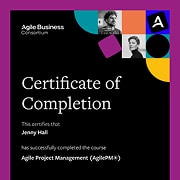
Gain a Recognized Course Certification
Upon successful completion, you’ll receive a digital certificate from the Agile Business Consortium, globally recognized by employers and professional bodies.
Access all 15+ courses for just £165/year
Enjoy unlimited access to CPD-certified content, join exclusive monthly networking events, and benefit from a premium library of resources and practical templates.
Related courses





Frequently Asked Questions
Our online courses are part of Individual Membership, so you’ll need to be a member to access them. Membership gives you the full library of courses alongside resources, events and our communities, all for £165 a year. You can become a member and start learning straight away.
The course is self-paced, so you can work through it whenever suits you and take as long as you need. Your access continues for as long as your membership is active, so there’s no pressure to finish by a set date.
No. Our courses are designed to be accessible whatever your background. Each course has a difficulty level (Beginner, Intermediate or Advanced) so you can choose what’s right for you, but there are no formal prerequisites to enrol.
Yes. On completing the course, you’ll earn a certificate endorsed by the Agile Business Consortium to add to your professional portfolio and share with your network or employer.
Each course is fully online and self-paced, made up of a mix of video lessons, practical activities, case studies and quizzes. You can learn at your own pace, on any device, wherever you are.