
Quotas, RICE and Everything Nice: How TechVill Prioritize
Discover how TechVill transformed its approach to prioritization to maximise business value as the organization scaled.

This is a case study from our Agility Impact Awards 2026 series. TechVill were awarded in the Continuous Learning category.
When everyone believes their work is the top priority, how do you decide what really matters?
For product and delivery leaders, it’s a familiar challenge. Stakeholders are competing for attention, development teams are stretched, and every new request arrives with a compelling reason why it can’t wait. As organizations grow, deciding what to work on next becomes increasingly difficult.
But what happens when the prioritization methods that once worked are no longer fit for purpose?
That’s the challenge TechVill faced while developing a food delivery mobile application for our partner VkusVill. Over three years, the organization transformed how it managed development capacity, evaluated competing initiatives and made investment decisions.
Its journey took it from capacity quotas to the RICE prioritization framework, and eventually to return on investment (ROI) as a way of comparing opportunities across teams.
Along the way, TechVill discovered an important lesson: effective prioritization isn’t about doing more work. It’s about making better decisions about which work delivers the most value.
Here’s how the organization evolved its approach, the challenges it encountered and what other product and delivery leaders can learn from its experience.
When everything is urgent, nothing is
In 2022, TechVill faced a significant scaling challenge.
Its product ecosystem had grown to include more than 50 stakeholders competing for development capacity, including over 30 business stakeholders, five architects and more than 20 connected systems and applications.
Meanwhile, around 200 people worked across business, analytics, design, engineering, QA and DevOps, organized into 12 product teams operating through quarterly Programme Increment (PI) Planning.
With so many competing interests, prioritization had become far more than a product management responsibility. It was now an organizational challenge.
Every stakeholder had requests they considered urgent. Teams were overloaded with incoming demands, and pressure to deliver continued to increase.
Hiring additional people was frequently discussed as a possible solution. But TechVill recognized that increasing headcount wouldn’t necessarily solve the underlying problem.
Without a structured way to manage demand, requests would continue to exceed available capacity, regardless of how many people joined the organization.
The team needed a better way to decide what work should be undertaken, and when.
2022: Creating stability with capacity quotas
TechVill’s first step was to introduce capacity quotas.
Rather than allowing every request to compete for the same development resources, the organization reserved portions of team capacity for three categories:
- Business requests: Work focused on delivering business needs and improvements.
- Platform improvements and technical debt: Work needed to maintain and strengthen the underlying technology.
- Unplanned work: A small uncertainty buffer to accommodate unexpected tasks.
The aim wasn’t to determine which individual initiative was most valuable. It was to create clearer boundaries around available capacity and prevent one type of demand from consistently overwhelming everything else.
And it made a difference.
Teams gained greater visibility of their actual capacity. Stakeholder pressure began to decrease, and the competition to secure development resources became less aggressive.
Importantly, the quotas also protected capacity for technical improvements that might otherwise have been displaced by subjectively more immediate business requests.
However, introducing quotas was only part of the challenge.
The hardest part was consistently protecting them.
Stakeholders still attempted to escalate requests, and teams had to maintain the agreed boundaries rather than allowing exceptions to undermine the system.
This revealed an important lesson for other organizations: a capacity model is only effective when people are willing to respect and defend it.
For TechVill, quotas created much-needed stability. But they didn’t completely solve the prioritization problem.
Because even when capacity was allocated fairly, another question remained: how should teams decide which initiatives deserved that capacity into every quota?
2023: Taking the emotion out of prioritization with RICE
By 2023, TechVill had identified a new problem.
Although capacity quotas helped manage demand between different categories of work, prioritization within those categories was still heavily influenced by individual stakeholders.
One architect might argue that migrating to microservices was essential. Another might champion a design system initiative. A third might insist that PCI DSS compliance needed immediate attention.
Each initiative sounded important. Each had potential benefits. And each had someone making a persuasive case for why it should take priority.
But without consistent evaluation criteria, decisions could depend on who communicated most confidently or persistently.
TechVill needed a way to make prioritization more objective.
Its solution was to introduce the RICE prioritization framework, which evaluates initiatives using four factors.
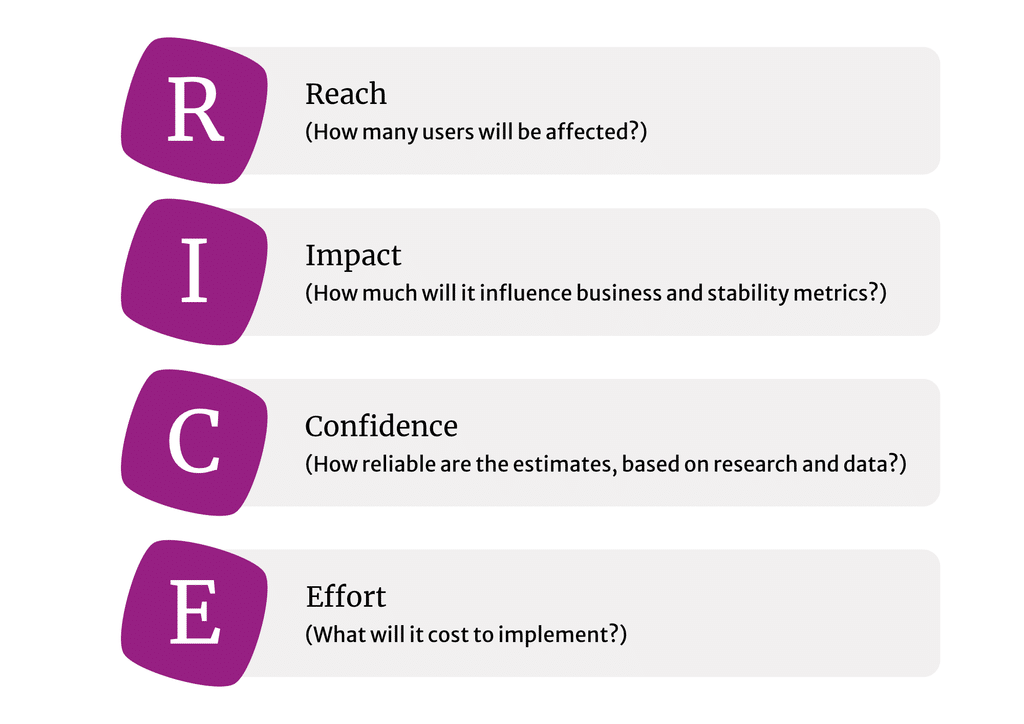
By considering these factors together, teams could compare initiatives using a shared set of criteria rather than relying on personal opinions.
However, implementing RICE wasn’t without its challenges.
The most difficult part was establishing a consistent understanding of Reach, Impact, Confidence and Effort across stakeholders.
After all, what one person considered high impact might be very different from another person’s assessment.
To make the framework effective, stakeholders needed to develop a shared understanding of how initiatives would be evaluated.
From competing opinions to constructive conversations
Once RICE was introduced, TechVill saw an immediate change in how prioritization discussions took place.
Conversations that had previously been emotionally charged became more focused and structured. Decisions were easier to explain and audit, and teams experienced less stress because priorities were no longer determined purely by stakeholder influence or escalation.
The framework also encouraged an important behavioural shift.
Rather than considering business importance alone, teams began evaluating the effort required to deliver an initiative.
Some projects with significant potential benefits were postponed because smaller initiatives offered better value relative to their implementation cost.
This challenged the assumption that the biggest or most ambitious initiative should automatically take priority.
For product leaders, the lesson is clear: prioritization becomes more effective when value and effort are considered together, and the reasoning behind decisions is visible to everyone.
RICE had helped TechVill introduce a common language for discussing priorities.
But as the organization continued to grow, the framework revealed another limitation.
2024: When goos team priorities aren’t good enough
By 2024, TechVill’s prioritization process had become more structured and transparent.
Yet a new challenge emerged: local optimization.
Some teams were overloaded with highly valuable initiatives, while others were working on comparatively low-value improvements because their most important work had already been completed.
Individual teams might be making sensible decisions about their own backlogs, but that didn’t necessarily mean the organization was investing its overall development capacity in the most valuable opportunities.
It was possible for teams to optimize their own work without optimizing outcomes for the wider business.
This was a different kind of prioritization problem.
RICE had helped teams compare initiatives, but TechVill now needed a common way to evaluate opportunities across different teams and domains.
Moving from RICE to ROI
To address this challenge, TechVill introduced ROI-based prioritization.
Instead of relying solely on relative scores, initiatives were assessed by comparing their expected business effect with the investment required to deliver them.
The business effect could include potential revenue growth or reductions in operational costs, while investment represented delivery cost.
This allowed the organization to evaluate initiatives through a common economic lens.
It also enabled more meaningful conversations about whether the expected benefits justified the resources being committed.
However, this was one of the most difficult organizational changes in TechVill’s journey.
Not every initiative has an obvious or immediate financial return.
Technical improvements, architectural changes and platform investments may generate indirect benefits or deliver value over longer periods. Estimating their economic impact required new discussions between business and technology stakeholders.
To support this transition, TechVill introduced shared prioritization dashboards and cross-team portfolio discussions.
These helped stakeholders focus on expected economic value rather than which team owned an initiative or who was advocating for it.
Better decisions across the entire big product
The impact was significant.
High-value initiatives could be reassigned to teams with lower-value backlogs, and initiatives unlikely to justify their investment could be identified before implementation.
Stakeholder conversations also became more constructive.
Rather than debating opinions or escalating requests, discussions increasingly focused on assumptions, trade-offs and measurable outcomes.
Transparent dashboards made the reasoning behind prioritization decisions more visible, helping reduce emotional tension and conflict.
For TechVill, this represented a fundamental change.
Prioritization was no longer simply about deciding what individual teams should work on next.
It had become a way of managing investment across the organization to maximize business value.
Three years, three stages of prioritization maturity
Looking back, TechVill’s transformation followed three distinct stages.
1. 2022: Stabilize capacity with quotas
Manage incoming demand, protect capacity for different types of work and reduce competition for resources.
2. 2023: Structure decisions with RICE
Introduce consistent evaluation criteria, reduce subjectivity and create a shared language for prioritization.
3. 2024: Maximise economic value with ROI
Compare initiatives across teams and make investment decisions based on expected business returns.
Each stage addressed a challenge that the previous approach couldn’t fully resolve.
Quotas stabilized the system but didn’t determine which initiatives offered the most value.
RICE introduced more objective prioritization but wasn’t sufficient for comparing investment opportunities across the entire product.
ROI enabled broader economic comparisons, helping TechVill move towards portfolio-level decision-making.
The important takeaway isn’t that every organization should immediately adopt all three approaches.
It’s that prioritization methods need to evolve as organizational complexity increases.
What can other product and delivery leaders learn?
TechVill’s experience offers four practical lessons for organizations struggling with competing priorities.
1. Start by getting control of capacity.
If teams are constantly overwhelmed by requests, introducing a scoring framework alone may not solve the problem. Capacity quotas can help establish realistic boundaries and protect essential work from being repeatedly displaced.
2. Make prioritization transparent.
Shared criteria and visible dashboards help stakeholders understand how decisions are made. This can reduce conflict, build trust and make it easier for teams to resist pressure to take on more work than they can deliver.
3. Recognize when your framework has reached its limits.
RICE can be highly effective for comparing initiatives within a growing product organization. But as complexity increases, relative scoring may not be enough to support decisions across teams with different responsibilities and opportunities.
4. Focus on overall value, not individual team output.
A team delivering its backlog efficiently isn’t necessarily delivering the greatest possible value for the organization. Looking at initiatives across the wider portfolio can reveal opportunities to redirect capacity towards more valuable work.
The biggest lesson: Value should speak louder than influence
TechVill’s story isn’t simply about introducing quotas, RICE or ROI.
It’s about recognizing when an organization has outgrown its existing approach to prioritization and being willing to change.
Over three years, TechVill moved from reacting to competing demands, to making structured prioritization decisions, and finally to managing its development portfolio through a common economic framework.
The result was greater transparency, less stakeholder conflict and a more considered approach to investing development capacity.
Perhaps the most important insight from the experience is this: when prioritization is driven more by the loudest voice than by measurable value, it’s often a sign that the organization needs a more mature operating model.
For product, delivery and Agile leaders facing similar challenges, TechVill’s journey offers a useful reminder.
You don’t necessarily need more people, more meetings or a bigger backlog to deliver better outcomes.
Sometimes, the most valuable improvement is changing how you decide what deserves to be done in the first place.
Facing your own prioritization challenges?
TechVill’s experience shows that there’s no one-size-fits-all approach to prioritization. As organizations evolve, so must the way they make decisions, manage capacity and deliver value.
You don’t have to navigate those challenges alone.
Join the Agile Business Consortium’s global community of Agile practitioners and leaders to exchange experiences, explore practical resources and learn how others are tackling the challenges of business agility.
Explore our Agile communities today!
For a full overview on all of our Agility Impact Awards stories, check out our special edition of Momentum magazine.
Featured organization

Written by

Fallon Taylor
Knowledge & Content Lead, Agile Business Consortium
Fallon is the Knowledge Management and content production professional who is dedicated to the pursuit of knowledge as a gateway to personal and collective growth. She focuses on the creating of engaging content that educates, inspires and sparks curiosity. With demonstrated experience in large organizations, Fallon is a logical thinker who identifies creative solutions for the intended audience.
Become a Member
Join today for exclusive member events, expert insights, practical resources and a global network of agile practitioners.
Not ready for membership?
Register for free to access selected content, follow upcoming events and get a feel for the Agile Business Consortium community.
Related blogs






Ready to lead change?
Join the Agile Business Consortium today. Access 50+ hours of self-paced learning, masterclasses, resources, and connect with agile practitioners worldwide.