
What is Agile?
Agile (with a capital “A”) refers to a defined set of values, principles and frameworks that guide how work is done. In simple terms, Agile is the method or system.

Agile describes a flexible, iterative approach to project management, originally defined in the Manifesto for Agile Software Development (2001), that values:
- Individuals and interactions over processes and tools
- Working solutions over comprehensive documentation
- Customer collaboration over contract negotiation
- Responding to change over following a plan
Rather than delivering everything at once in a linear waterfall fashion, Agile promotes incremental delivery where manageable product increments or solution increments provide additive business value.
The History of Agile
In its original context, Agile transformed software development by enabling teams to deliver working software in small, frequent releases. This improved quality and responsiveness to user needs. Practices such as iterative development, continuous feedback and close collaboration between developers and stakeholders have become central to modern software delivery.
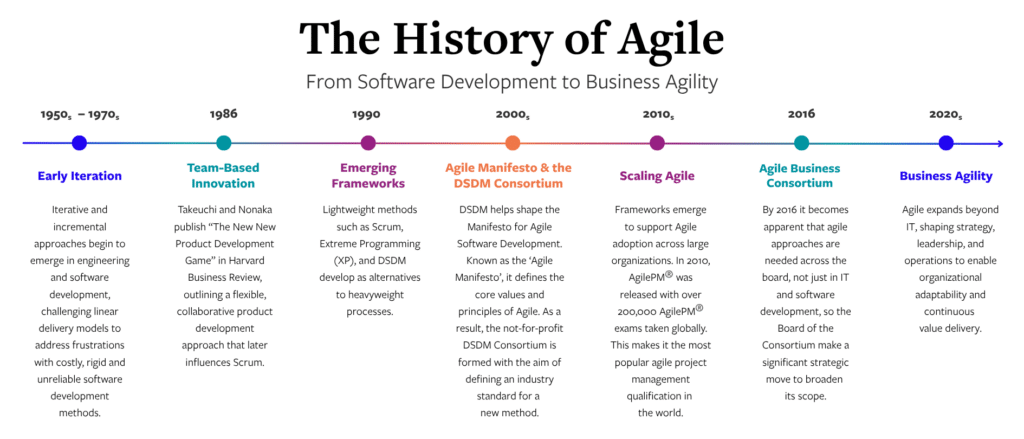
Earlier approaches such as Dynamic Systems Development Method (DSDM), developed in the 1990s, were among the first to formalize iterative delivery and active user involvement, helping to shape what would later become Agile thinking.
While the Manifesto for Software Development originated in software, its values have since proven appliable far beyond IT. They now shape how teams across entire organizations structure their work through a range of Agile methodologies.
What is Agile methodology?
Agile methodology is a way of working that breaks work into small, manageable cycles known as iterations or sprints.
While agile methodology describes this overall approach, in practice it is applied through a range of agile methodologies. These are specific frameworks that bring these principles to life. Scrum is one of the most widely used, structuring work into time-boxed sprints with defined roles and regular review points to support continuous improvement. Kanban, by contrast, focuses on visualizing workflow, limiting Work in Progress (WiP) and enabling a steady flow of value. Other approaches such as Extreme Programming (XP), emphasizes strong technical practices like test-driven development, while Lean Agile focuses on reducing waste and maximizing customer value.
Originating from the 2001 Agile Manifesto, these methodologies have evolved far beyond software development. Today, organizations often blend multiple approaches to suit their context, reflecting a shift from applying individual frameworks toward embedding agile ways of thinking across teams and the wider enterprise.
What is the difference between Agile and agility?
It is crucial to distinguish between Agile and agility.
Agile (with a capital “A”) refers to a defined set of values, principles and frameworks that guide how work is done. In simple terms, Agile is the method or system.
Agility represents the competence to adapt successfully to rapidly changing environments. At scale, this becomes Business Agility.
You can adopt Agile frameworks, but that doesn’t automatically mean you have agility. True agility comes from how well those practices are embedded through culture, leadership and a growth mindset so that the organization can respond effectively to change.
What is Business Agility?
Business Agility is an organizational competency that enables organizations to deliver value to customers, employees, shareholders and their wider ecosystem in an increasingly unpredictable, changing world.
It is explicitly not another framework to implement; it is a mindset and competency which is developed through continuous learning. The terms organizational agility, corporate agility, or enterprise agility are often used interchangeably with business agility.
Business Agility balances “being agile” through culture, leadership, and governance with “doing agile” in delivery. This combination, powered by collaborative and creative ways of working in empowered teams, enables the organization to pivot strategically when needed and continuously deliver value.
“Organizations demand a new version of leadership that’s not only human, adaptable and resilient, but supports others to be the same. True agility starts with leaders who create safety, invite dissent, and reward learning over certainty”
Katie Taylor, Learning and Development Lead/Chair of the Board, Agile Business Consortium
To support this journey, the Framework for Business Agility can be used to guide how the competency of Business Agility can be developed and applied across an entire organization.
What is the Framework for Business Agility?
The Framework for Business Agility (FBA) provides lenses to assess the agility of an organization. It will help you to ask the right questions within your teams and organization to define which areas you want to improve. It is comprised of four circles:
- Being Agile – At the core is “being agile” including agile leadership, agile culture and agile governance.
- Doing Agile – In the circle surround the core is “doing agile” including agile operations, agile support and agile change.
- Strategy – The circle connecting “being agile” and “doing agile” with the value delivery circle. This circle bridges the internal workings of the organization with its external presence.
- Value Delivery – This is the value your organization is delivering to the outside world
Written by

Become a Member
Join today for exclusive member events, expert insights, practical resources and a global network of agile practitioners.
Not ready for membership?
Register for free to access selected content, follow upcoming events and get a feel for the Agile Business Consortium community.
Related blogs






Membership for people leading change
Become a member to access agile communities, practical on-demand courses and exclusive events that help you build capability, grow your network and lead change with confidence.
Use code DISCOVER20 during checkout to save 20% off your membership. Valid until 31 July 2026.
Looking for organizational membership? Find out more here